The Secret Commonwealth re-read
TL;DR: A complicated slog

Honestly, I was dreading this book as part of my reread of Philip Pullman’s linked trilogies on my way to the final book, The Rose Field.

As I described in the previous post, the first book in Pullman’s second trilogy, La Belle Sauvage, features Lyra Belacqua as an infant in terrible danger from a crazed former priest and a massive flood.
The Secret Commonwealth opens 20 years later. Lyra is a university student, often melancholy as she wrestles with her classes. She reunites with the now adults who saved her from the flood, Malcolm Polstead and Alice Lonsdale. They are part of a secret spy network that opposes the authoritarian Magesterium.
The most striking change is Lyra’s painful estrangement from Pantalaimon, her pine marten dæmon. Pan is her soul; yet what little time they spend together is often bitter and accusatory.
This is partly due to Lyra’s obsession with the books she’s reading, hyper-rationalist and nihilistic philosophy and literature. Any college undergrad might feel the same. Through Pullman’s telling, these books reject the world of myth and folklore and embrace logic and facts. Anything that cannot be measured or proven is dismissed as fanciful claptrap. One author even denies the existence of his dæmon, which sends the creature into deep depression.
In my first read, this estrangement bothered me. I felt that Pullman was breaking his own rules of how his world worked. He’d made it clear that people and their dæmons cannot separate (except for witches). When Lyra and Pan separate in the first trilogy, during her journey with Will to the land of the dead, the pain is almost unbearable and they quickly reunite.
This time around, I found the device more convincing. Lyra has lost her capacity for wonder. Pantalaimon feels this acutely. Told that she will soon have to leave the university entirely, Lyra is without clear direction or purpose. This mirrors the experiences of many young adults I know, who both crave independence, are nostalgic for the past, and fear the “adulting” that comes with maturity.
Lyra has also lost her savant ability to read the alethiometer, the truth-telling device that was so central to the first trilogy.
The loss of that power was painful. It was a consolation, though a poor, thin one, to know that by diligent study [Lyra’d] be able to regain some of the ability to read it; but she’d always need the books in which generations of scholars had set down their discoveries about the symbols and the links between them. The contrast, though! It was like losing the power to fly through the air like a swift, and being compensated with a crutch to help her limp along the ground.
I’ve sensed a similar confusion in my 20-something students at Duke. With the advent of Artificial Intelligence, many have lost a sense of identity and faith in the future. Why are they earning (and paying for) degrees for jobs that will no longer exist? What is university even for if the skills you acquire are completed faster and more accurately by a machine?
No one seems able to provide a convincing answer or path forward.
The Magesterium remains a brooding menace, corrupting even the good-hearted people within it. The power of religion has not dimmed at all after the events of the first trilogy, including the fall of the deity and the attack on heaven. Lyra’s parents—Lord Asriel and Mrs. Coulter—are dead but Lyra’s grandmother, just as fearsome as her daughter and a powerful figure within the Magesterium, remains capable of scheming for Lyra’s destruction (what a family!).
The story kick-starts when Pan witnesses a murder by Magisterium agents. Before dying, the murdered man’s dæmon relays to Pan a secret. In the deserts of the East, a unique rose produces an oil capable of revealing the true nature of Dust. The pro-freedom characters want to protect the roses; the Magesterium wants to destroy them and any power to challenge their stranglehold on society.
One reviewer noted that the second trilogy seems written for the adults who were children when the first trilogy was published. So it’s not really a YA book (though some determined kids might love it).
On my second re-read, this plot felt repetitive. Wasn’t an inquiry into Dust—the manifestation of human thought, self-awareness, and spirit—the engine of the first trilogy? Wasn’t there a titanic struggle between the forces of freedom and an authoritarian church?
Are we after the same MacGuffin? Here’s Pullman explaining his approach to the linked trilogies.
Honest reaction: I lost my way early on and eventually resorted to online plot summaries (a modern alethiometer) to figure out what was going on. Pan abandons Lyra to search for her lost imagination. For her part, Lyra discovers that Oxford is no longer safe and flees to the gyptians in the fens.
Meanwhile, Malcolm Polstead is also investigating this mysterious rose. He crosses paths with the brutal Olivier Bonneville, the son of Gerard, who tried to kill Lyra in La Belle Sauvage (and who Malcolm killed).
Although Lyra is supposedly without imagination, she accepts without question the gyptian notion of a “secret commonwealth”: a hidden world that cannot be explained by standard science or strict rationalism. This is where fairies, water spirits (like the ones Malcolm encounters in La Belle Sauvage), ghosts, alchemists, witches, and abandoned or separated dæmons exist.
I love this idea and the title but, once again, there was a head-scratcher. If Lyra (who was suckled by a water sprite in La Belle Sauvage) can accept this shadow world, how is it that she’s “lost her imagination”? Instead of being told from the point of view of one or even two characters, Pullman chose a multitude: Lyra, Pan (separated from her), Malcolm Polstead, and Magesterium agents, among others, each on a separate quest.
Pullman tilts at so many windmills—belief and non-belief, autocracy, the nature of imagination, literature that challenges the mind so deeply that one loses hope—that my eyes glazed over.
In Lyra’s struggle, I felt an uncomfortable echo of how C.S. Lewis treated Susan Pevensie in the “Chronicles of Narnia.” Once Susan reaches puberty, she can no longer access the fantasy world, a cruelty I felt deeply as a young female reader. Pullman has criticized Lewis for this rejection of female sexuality and, I thought, approached it quite differently with Lyra, who does have sex and can still connect with a fantasy world.
But is Lyra’s embrace of rational philosophy a less sexual and more intellectual slap against a female? Malcolm knows this same literature, yet retains a healthy relationship with his imagination, his cat dæmon, and the secret commonwealth.
To be fair, some critics blame Susan for cutting choosing dresses and manicures over Narnia (“She always was a jolly sight too keen on being grown up”). What I’d say is that, as a young reader, I got the message loud and clear that while boys could grow up and still enter Narnia, girls could not because of something bad and dangerous about their sexuality. To me, Pullman comes a bit too close to that same dismissal as Lyra, rightly, delves into challenging reading.
I had assumed that Pullman was a defender of knowledge and challenging ideas. This subplot confounded me. It seemed weirdly anti-ideas (and anti-female) when the whole point of the first trilogy was the power of a determined girl and the freedom of ideas against a suffocating religion.
And how could a dæmon like Pan “find” a lost imagination? The concept seemed plucked from a much simpler children’s picture book.
For me, The Secret Commonwealth shares some of the flaws of The Amber Spyglass, including a largely passive Lyra. The brave, prickly girl who fought evil, saved her friend, and befriended an armored bear seems long gone. The story includes too many names and places, too many unexplained quests, too many side stories that don’t contribute to the central spine of the tale.
Sometimes, I felt like Pullman used the word “mystery” when the story was at its most tangled and confused. “Mystery” or too much crammed in one story without much logic or connection?
I wondered: is Pullman the kind of writer whose success means that no one can edit him effectively? This book NEEDED an editor.
I basically gave up about page 400 (of 633) and skimmed. In his comprehensive review on Words and Dirt, critic Miles Raymer seemed to agree with me. After a promising start, The Secret Commonwealth “slowly and tragically dissolves into a narrative so desultory and dull that it may as well not exist.” Once Lyra and Pan go on their quests, the story becomes “rudderless” and drops any sense of a compelling through-line.
The Nerd Daily noted that flitting between so many disparate points of view renders the middle section sluggish and confusing.
To be fair, others loved the complexity and especially the James Bond spy thriller aspect that dominates the final half. “It’s thrilling and subversive and dark as all hell (and that’s not just the salty language),” wrote Bookmunch. “We blasted through the book (…) and we would heartily recommend it to any and all Pullman fans but specifically those people whose interest may have waned in the whole Lyra-verse.”
I’d love to know your opinion!
One completely marvelous thing (in all the novels) are the covers and interior art by Chris Wormell (find him on Insta). The images capture both story details and the vast expanse of Pullman’s world. The cover evokes Istanbul’s Blue Mosque and the sunset passage of the fabled Orient Express. What I imagine is Lyra’s profile appears in the lit window furthest to the left.
I also have the illustrated 25th anniversary edition of The Golden Compass, featuring Wortmell’s art. It’s wonderful.
More adult books should be illustrated!
Book Ban update
I’ve started volunteering with Authors Against Book Bans and will include brief updates in future newsletters (my fist raised against our contemporary Magesterium).
Censorship is a children’s rights issue, not just a free speech issue. Increasingly, opponents of free speech are targeting non-fiction books for kids.
Some of the most banned non-fiction titles are surprising:, among them Aztec, Inca, and Maya by Elizabeth Baquedano (one of the DK Eyewitness Books Series and singled out for the approach to teaching race, gender, and historical oppression), and Night by Elie Wiesel, a Holocaust survivor memoir first published in Yiddish in 1956.
Holocaust denial, I guess.
The Bond audiobook
If you are looking for summer listening, check out The Bond!
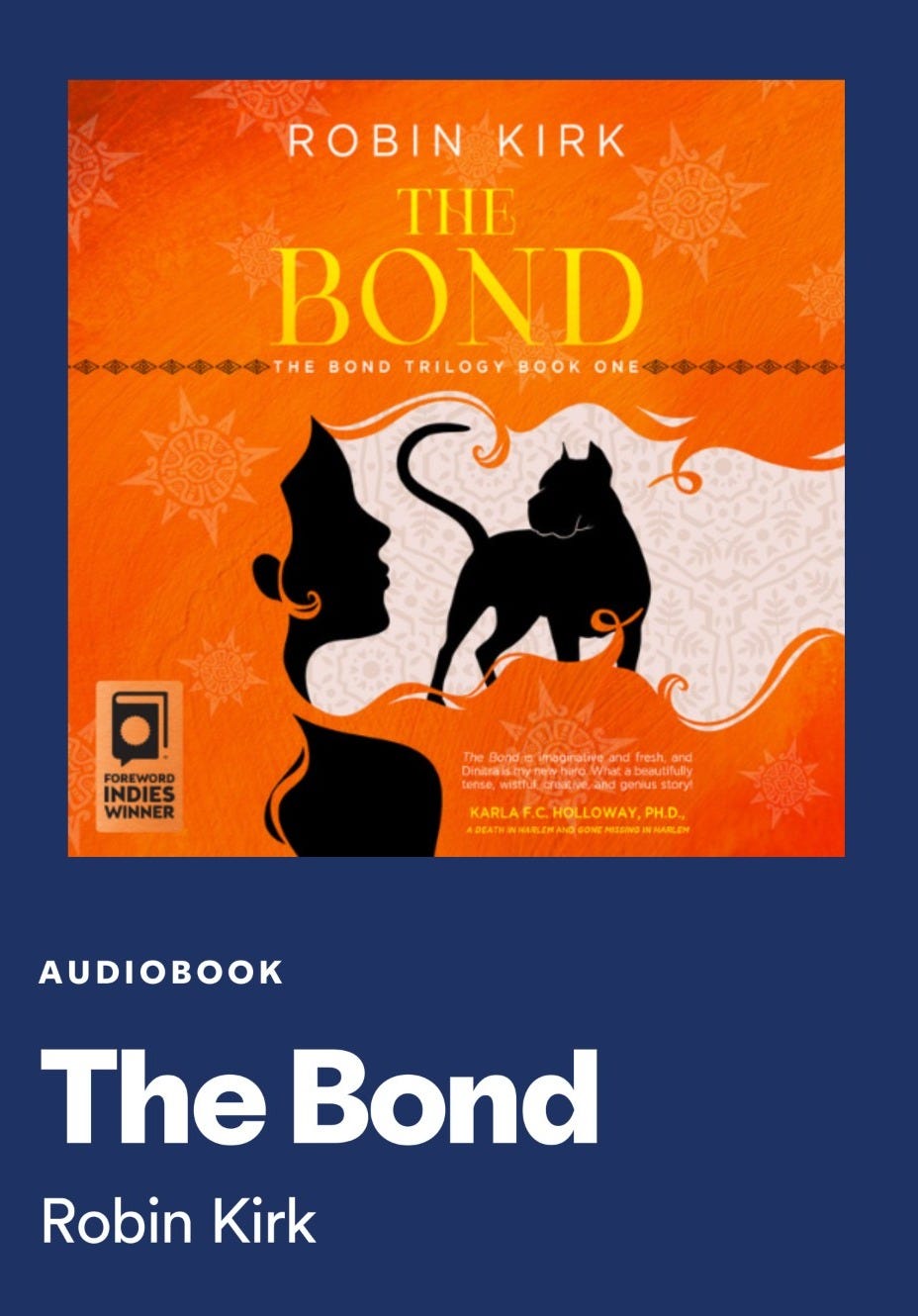
On Spotify
Best recent photo