
The Subtle Knife re-read
TL;DR: short on gender relations, long on adventure

In preparation for reading The Rose Field, the last of Philip Pullman’s linked trilogies, I set out to re-read the previously published books from the beginning.
With Book II in Trilogy One, there’s so much I missed the first time around!
As before, spoiler alert!
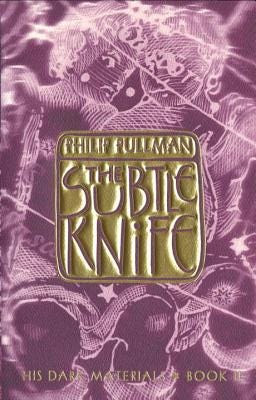
As many reviewers noted since the book was released almost thirty years ago (pause for shock), the story takes risks that many fantasy writers avoid. First and most daring, Pullman switches to a third-person limited point of view, focusing primarily on a new character, Will Parry. A twelve-year-old boy, Will is being raised by a single mother in our world. His father, an explorer, left them when Will was still very young.
His mother is troubled, suffering from an obsessive-compulsive disorder that may be tied to the father’s disappearance. Will feels a sense of purpose—he knows he must solve the mystery of his father’s disappearance—but doesn’t know how to accomplish this and also keep his mother safe.
Then burglars enter the home they share. Will suspects this has to do with his father. He confronts them, accidentally killing one of them. After he settles his mother with his piano teacher, he flees, finding a split in the fabric of the world that leads into a connector place linked to other worlds, including Lyra’s.
Lyra’s there, too, having followed the hole that her father, Lord Asriel, violently blasted through the northern lights by murdering Lyra’s childhood friend, Roger (the finale of The Golden Compass). What follows is a kind of buddy adventure, with Will taking the lead.
Just as Lyra is the bearer of the truth-telling alethiometer, Will becomes the bearer of the subtle knife.
The knife is capable not only of slitting the invisible membrane separating worlds; it is the one weapon powerful enough to kill The Authority, the angel that Lord Asriel is determined to confront, to free all worlds from the tyranny of the Magisterium, Pullman’s stand-in for tyrannical religion.
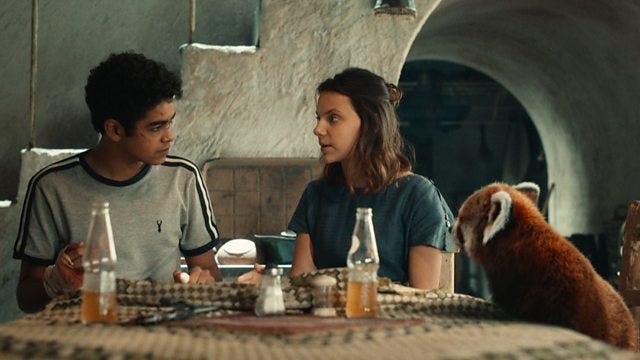
The introduction of new, adult points of view—including our-world scientist Mary Malone—makes The Subtle Knife a more challenging read, especially for younger readers. Pullman has always been challenging, to be fair. I wonder if, thirty years later, his complex and sophisticated story would stand a chance of publication, especially marketed for kids.
For me, Lyra faded too far into the background on this read. One of the most delightful aspects of The Golden Compass is how ornery, stubborn, and deceitful Lyra is. She doesn’t set out to please or placate anyone. But in The Subtle Knife, she is secondary to Will and his quest.
In interviews, Pullman has often spoken forcefully about his objections to C.S. Lewis’s Narnia books and their prudishness (including the idea that puberty ends a child’s access to a fantasy land). Lewis, an old-style Anglican, reserves special shame for Susan, the eldest girl. While her brothers and younger sister also eventually lose access, in The Last Battle, Lewis singles Susan out for shame due to her interest “in nothing nowadays except nylons and lipstick and invitations.”
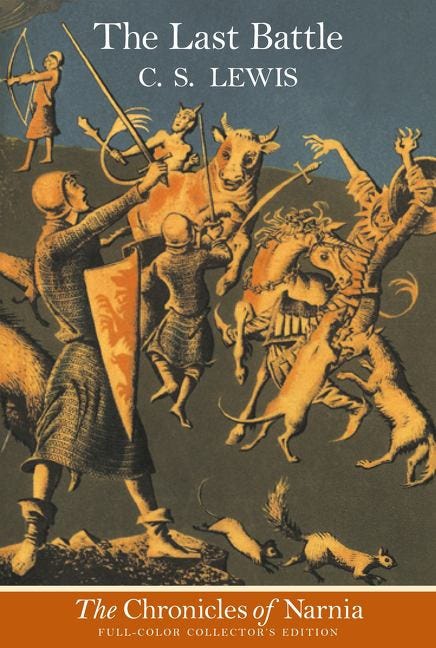
Objections may be too mild a word. Pullman has called the series “one of the most ugly and poisonous things I’ve ever read,” “vile,” “life-hating,” “nauseating drivel,” “loathsome,” “disgusting,” and “containing a view of life so hideous and cruel I can scarcely contain myself when I think of it.” (Phew)
Note: I still love this series. But I do remember reading it as a child and feeling angry at how Susan was treated. Even then, I picked up on Lewis’s misogyny.
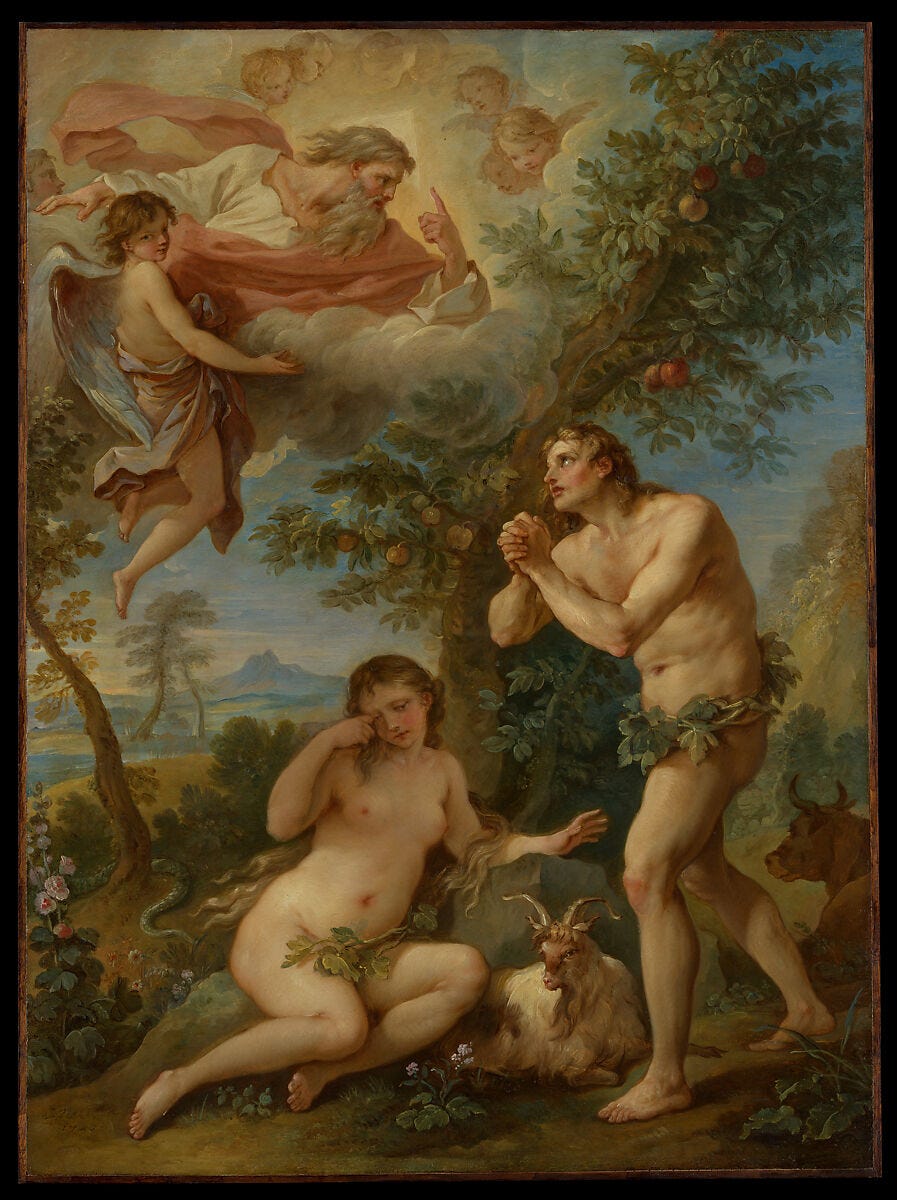
In this reread of The Subtle Knife, I found myself (mildly compared to Pullman’s views on Lewis and my reactions to Susan’s banishment from Narnia) disappointed in how the portrayal of Lyra changed. By now, Pullman has revealed (through a myth shared by the witches) that Lyra is meant to be a new Eve and lead humanity away from the divine and toward independence.
Yet I felt, as I read, the implied strictures of contemporary gender roles. Pullman portrays Lyra not as Eve the prophet and bold leader, but Eve as help-mate to Will/Adam, a broody and sometimes ruthless hero. More sharply than during my first read, I also felt the difference in the way Pullman describes Lyra’s parents, including Mrs. Coulter.
For me, both characters are monstrous. Asriel murders a child to open a gap between worlds. Mrs. Coulter “incises” poor children from their daemons, killing them. Yet Pullman sets out Asriel as an inspiring leader while (so far in the trilogy) Mrs. Coulter and her golden monkey are terrifying and evil. Mrs. Coulter’s sexuality is meant to disgust and horrify, especially when she uses it to literally give Lord Boreal a fatal heart attack.
In a master of arts thesis, Cheryl Lyn Black describes how Pullman’s world conforms all too easily to modern gender norms. There are no female panserbjørn, the armored polar bears; the gyptians are a patriarchy; and in our world, Will’s mother is mentally ill and in need of protection, something that Pullman largely leaves unexplained (is she mentally ill or besieged by invisible spectres?).
“However, the ubiquitous patriarchy in Lyra’s world contains one exception--the Lapland witches,” Black writes, “an exclusively female culture of beautiful and magical human-like women…Instead of adding another dimension to the complexity of gender roles in the trilogy, the witches again fall into preconceived notions of what it means to be female.”
I would add one more: the scientist Mary Malone. In Pullman’s framework, Malone is the “serpent.” In The Amber Spyglass, she tells Lyra and Will about her own sexual awakening, thus giving them a kind of permission to profess their feelings for one another.
But her thread of the story feels a little like a fly-away hair. She is off doing things, apparently important things, but how those things relate to the core of Pullman’s theme is hard to discern. As much as I love this world and the characters, this reread revealed some of the worn underpinnings and loose hinges of Pullman’s worldview.
That said, the story takes flight (balloon-wise, also, in the form of Texan Lee Scoresby) in the last third. Will and Lyra manage to escape the evil Lord Boreal and begin the fateful trek north, in the hopes of finally finding Will’s father (Stanislaus Grumman, Jopari, John Parry: Pullman, like Tolkien, loves his names).
I paused multiple times to savor lines like these.
The sky was now colored like a tiger; bands of gold alternated with patches of deepest brown-black, and the pattern changed by the minute, for the gold was fading rapidly as the brown-black engulfed it. The sea behind was a patchwork of black water and phosphorescent foam, and the last of the burning zeppelin’s flames were dwindling into nothing as it sank.
Overall, I agree with Gregory Maguire’s New York Times book review. Pullman’s fumbles on gender norms are irritating. But the story remains a thrilling and complex adventure.
Just when narrative sprawl is about to overwhelm, the ‘subtle knife’ of the book's title shows up. It can slice through anything -- spirit, matter and middle book syndrome.
On to The Amber Spyglass!
Thank you for this! I haven't reread this series in a long time, but I remember it in enough detail to see all your points. At the time of reading it was amazing to have an adventurous, independent girl as the main character! It's hard to explain to someone who didn't live through the 80s and 90s how impossible that seemed at the time. So I overlooked many of the gender stereotypes that were clearly present in the series. Years later, I expect a lot more from my books and now see this series as a stepping stone to how we got to a better place in literature. Here's to us stepping further and further up the staircase to equity!